Congratulations to Smiljan Radić Clarke, 2026 Laureate of the Pritzker Architecture Prize! Open Access Now: Weaving Spaces with Words
Manijeh Verghese“A picture is worth 1,000 words”[1] is an old adage that many architects cling to—believing that their pristine renderings, detailed drawings, and other visual material triumph over something as mundane as text. But this is not always the case. Text is a medium that allows for creation, imagination, and flexibility; it is a common language used by architects, clients, consultants, and the general public for communication, which subsequently gets translated into spaces.
Text puts the author in dialogue with the reader, who draws from his or her own references to construct and visualize a space or an idea. It allows the architect to communicate intent by constructing immersive and imaginative structures or landscapes with words, which are then populated by the reader’s imagination. The imagined outcome is a shared project, no longer solely controlled by the architect.
Text is similar to architecture in that it has structure, constraints, and an agenda. Through words, it weaves together plot lines and characters to create narratives, hence describing spaces, navigating cities, and constructing scenarios. Defined as a collection of written or printed words on a particular subject that forms a connected piece of writing, text is a medium commonly used to disseminate ideas.
Text originated as a late Middle English term, derived from the Old Northern French texte, which in turn came from the Latin textus or tissue and the verb texere, meaning “to weave.” Used consistently since the word was invented, its popularity was especially pronounced starting in the mid-twentieth century, when more forms of text such as manifestoes, speeches, scripts, novels, magazines, cookbooks, or even teleprompting became widespread. This was followed by the invention of the Internet, which ushered in a whole new set of languages and words—from blogs to Wikipedia to HTML or CSS coding. The importance of text increased exponentially.
The idea of a piece of writing as a connective tissue of ideas or a woven web of words that creates architecture is present in the work of Georges Perec, who was famous for using strategic constraints[2] to imagine new forms of written space. Perec was a member of the Oulipo group,[3] a circle of French writers and mathematicians who used lipograms (texts which deliberately exclude certain letters) and palindromes (words or sentences that read the same forward as they do backward). Sometimes they would even appropriate the mathematical logic of chess tactics, in order to take us through a story or set of spaces by visiting each only once and not in a straightforward sequence.
Perec’s Oulipian style was exemplified by his book The Void (1969) that never used the vowel “e” or his novella Three (1972) where “e” is the only vowel allowed in the text. Most famously, he is known for his book Life: A User’s Manual (1978), a story which takes us through the lives of the inhabitants of a Parisian apartment building, hence constructing their domestic spaces and in turn their lives, before revealing that this elaborate puzzle of narratives coexisted simultaneously in a single moment. Text, in Perec’s example, gives the author the power to collapse space and time.
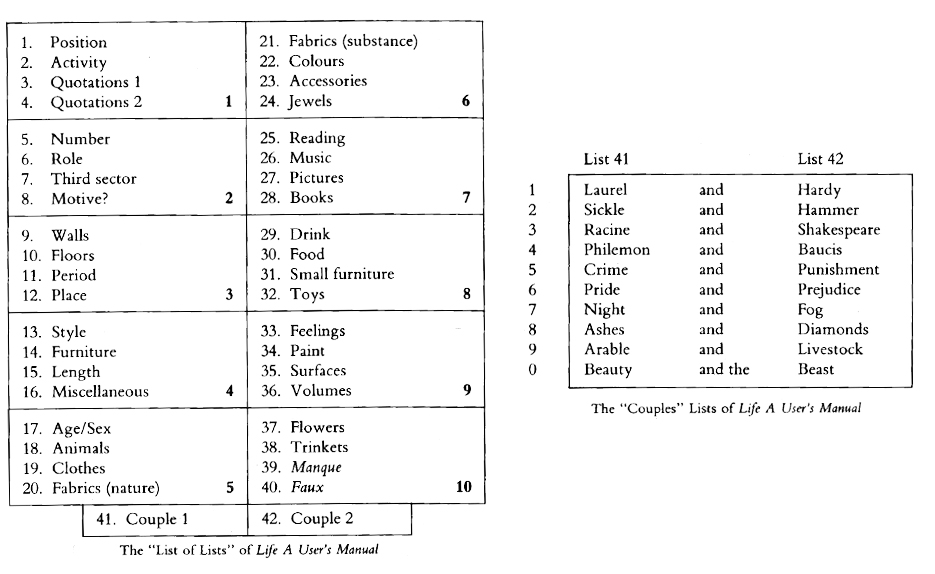
Georges Perec’s novel Life: A User’s Manual is based on 42 lists of 10 elements each, to be included in the 99 chapters which represent the 99 rooms of the apartment building block in which the story is set. © Georges Perec, in: David Bellos, Georges Perec: A Life in Words: A Biography (Boston, 1993).
Around the time that the novel was written, during the 1960s and 1970s in France, there was an architectural shift away from modernism toward postmodernism, or at least a less clinical, mechanical approach to space in favor of celebrating everyday encounters and inhabitation. There was a desire to see how quotidian life played out behind the repetitive city block’s façades. It was also a time where text emerged in France as a key architectural medium to express new “theoretical and historical studies that examined urban morphologies and architectural typologies.”[4]
Perec’s circle of friends included Paul Virilio and Henri Lefebvre, who must have influenced his writing to make him aware of these architectural shifts. But also within the literary tradition, Perec was influenced by the nineteenth-century French “building” novels written by Victor Hugo, Gustave Flaubert, and Émile Zola, to name a few. Here, architecture became a stage set as intricately designed and delineated as the narrative itself. No longer was space seen as a frame or a backdrop, but instead it became a character in the story. In Life: A User’s Manual, Perec goes one step further to make architecture the hidden protagonist of his novel. His Oulipian recursive devices are no longer employed purely to constrain the text, but rather to construct the space of the narrative. For this reason, scholar Peta Mitchell describes Perec’s novel as an “architext”[5]—a piece of writing where the spatial and written structures are inseparably intertwined.
Life: A User’s Manual uses a structural/compositional system that Perec invented and which he referred to as a story-making machine. The book consists of forty-two lists of ten objects, positions, names, or plots, which Perec then divided into two series of twenty-one elements each. Using a mathematical system called the Graeco-Latin square of order 10, Perec combined the elements in such a way that a unique arrangement of the forty-two elements was achieved for each of the ninety-nine chapters and the epilogue of the book. The constraint also mirrors the structure of the apartment building in which the novel is set, and which Perec determined would have a ten by ten grid of floors and rooms including one stairway. The complexity of Perec’s constraints, as well as how he moves the reader non-sequentially through the whole building, is reminiscent of a difficult jigsaw puzzle, which in turn reemerges as a central theme of the story, as the main character sets himself the task of solving jigsaws of paintings he made during a twenty-year trip around the world.
Perec’s ability to bring the fictional apartment block at 11 Rue Simon-Crubellier to life is a result of his mastery of descriptive text, which he uses in order to mask the constraints and devices with which he constructs his narrative, until certain moments when he carefully reveals them to his readers as part of the story. Through words, he takes us up stairs, through doorways, along corridors—transporting us into a fictional world of his making without really revealing the sheer complexity of his written constructs. But Perec’s descriptions are not limited to the spatial interiors of the different apartments and their embedded narratives; they also extend to the works of art that some of the inhabitants have created and that in turn reflect his overall ambitions for this text. The final lines of the book’s epilogue zoom out to ultimately describe the spatial construct we have been moving through over the course of the story: “The canvas was practically blank: a few charcoal lines had been carefully drawn, dividing it up into regular square boxes, the sketch of a cross-section of a block of flats which no figure, now, would ever come to inhabit.”[6]
Just as Perec constructed space by using text, architects too have invented theories and projects with words. From the earliest texts by Vitruvius in the first century BC with his Ten Books on Architecture to Bruno Taut whose year-long chain of letters between himself and twelve fellow architects in 1919 formed the basis of expressionist architecture in Germany, there is a long history of constructing textual space. Others include the theoretical essays of Peter Eisenman or Le Corbusier and Pierre Jeanneret’s “Five Points Towards a New Architecture.” Throughout history, architects have used text to disseminate theories, manifest ideas, and to analyze and clarify their thoughts. As Adolf Loos said in 1924: “I have no need whatsoever to draw my designs. Good architecture, how something is to be built, can be written. One can write the Parthenon.”[7]
But all too often, Loos’s wise words articulating the ability of architects to design space through text is neglected in favor of the visual language of images and renderings. In the mediated world of contemporary architecture, the immediacy of photo-realistic depiction—which does away with imagination by simply presenting a finished image—reigns supreme. Of course, making a convincing image takes time, skill, and effort. As a technique, rendering can be effective but its ubiquity as a form of architectural representation is what should be questioned. The complexity of a space described through words is often reduced to a one-liner when condensed into an image.
The issue perhaps lies in the inherent contradiction within the profession of architecture. Buildings as physical structures are not representational, but since architects do not physically construct their edifices, they instead have to rely on drawings, images, films, and models—on media which are representational of the final output. This distance between architect and building is hard to bridge, and the medium through which the design is expressed needs to be chosen carefully to best communicate the idea. By utilizing text in lieu of more visual formats, architects can remain within the realm of non-representation—harnessing the powers of description to catalyze the imagination and thereby arrive at their intention for the built proposal.
When Chilean architect Smiljan Radić announced his proposal for the 2014 Serpentine Pavilion, a short paragraph of text—accompanied by some rendered visualizations—recalled the sixteenth-century tradition of the romantic folly. The pavilion was described as “a fragile shell suspended on large quarry stones. This shell—white, translucent and made of fiberglass––will house an interior organized around an empty patio, from where the natural setting will appear lower, giving the sensation that the entire volume is floating. At night, thanks to the semi-transparency of the shell, the amber-tinted light will attract the attention of passers-by, like lamps attracting moths.”[8]
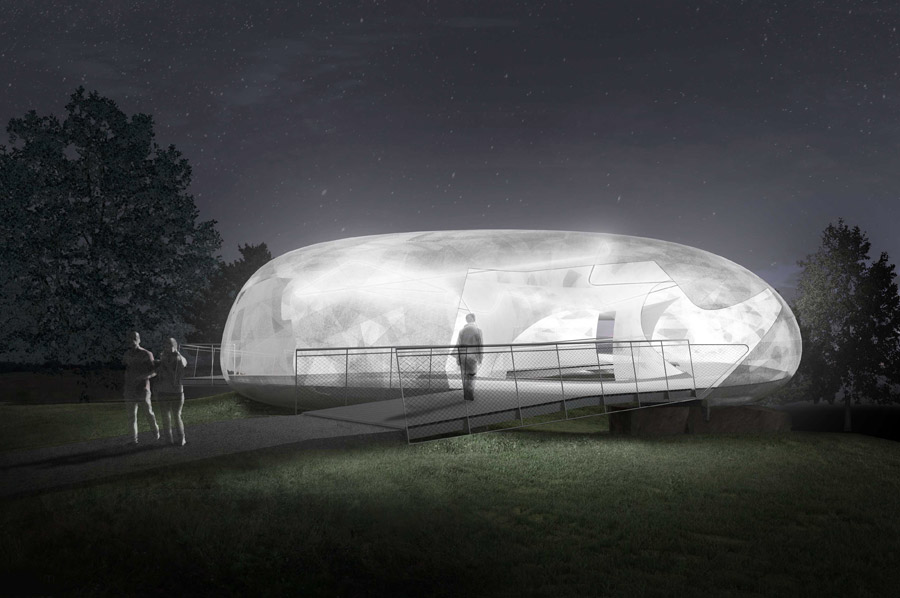
These evocative words conjured images of ephemerality and lightness. The delicate, translucent form that Radić describes, with its contrasting materiality and the historical tradition of follies in the landscape that he was building into, immediately made me imagine what it would be like to be inside that space. By contrast, the weighty Paleolithic forms found in the adjacent renderings felt too static, opaque, and solid. The cold, white lighting was harsh and too impersonal. They were missing the intangible qualities of warmth, sound, movement, and inhabitation as suggested by his words.
The powerful descriptive paragraph that Radić wrote in that press release was what drew me in initially, but it wasn’t until later that I discovered the full extent of the role that text plays in his work. While the Serpentine Gallery probably insisted on the importance of creating visuals to announce the new pavilion for press purposes, text is something that has always been instrumental in Radić’s practice. He uses words, poems, novels, and even fairy tales not just to describe his work but as an active part of his design process and as a source of inspiration. As Fabrizio Gallanti also observes: “The way Smiljan Radić develops his architecture is reminiscent of the creative processes of writing.”[9] He begins with inspiration and an idea, before testing how the two can be combined through models. He is not afraid to look to other professions for references and ways to push his idea even further, typically drawing on pieces as disparate as architectural texts by Le Corbusier and poems or short stories by Jorge Luis Borges.
In our interview Radić explains his use of text as a form of ekphrasis, which for him means “to visualize something that just exists in text.”[10] At the opposite end of the spectrum to Perec, Radić is interested in how existing narratives can be translated into spaces and sculptural forms. Perec used his novel to critique the ubiquitousness of the Haussmannian apartment block in Paris with its fixed heights and limestone façades that were spread across the city as if rolled off an assembly line. By removing one such façade at the fictional address of 11 Rue Simon-Crubellier, Perec reveals a hive of activity, each room intensely individualized within to belie their standardized façades without. While in the case of both Perec and Radić there is a large degree of invention, they come at it from different angles: Perec invents narratives for the inhabitants of the archetypal Parisian apartment block, taking inspiration from reality to construct fiction, while Radić is inspired by stories and fairy tales to construct physical space, inventing enclosures, fissures, and new materials to bring a story to life.
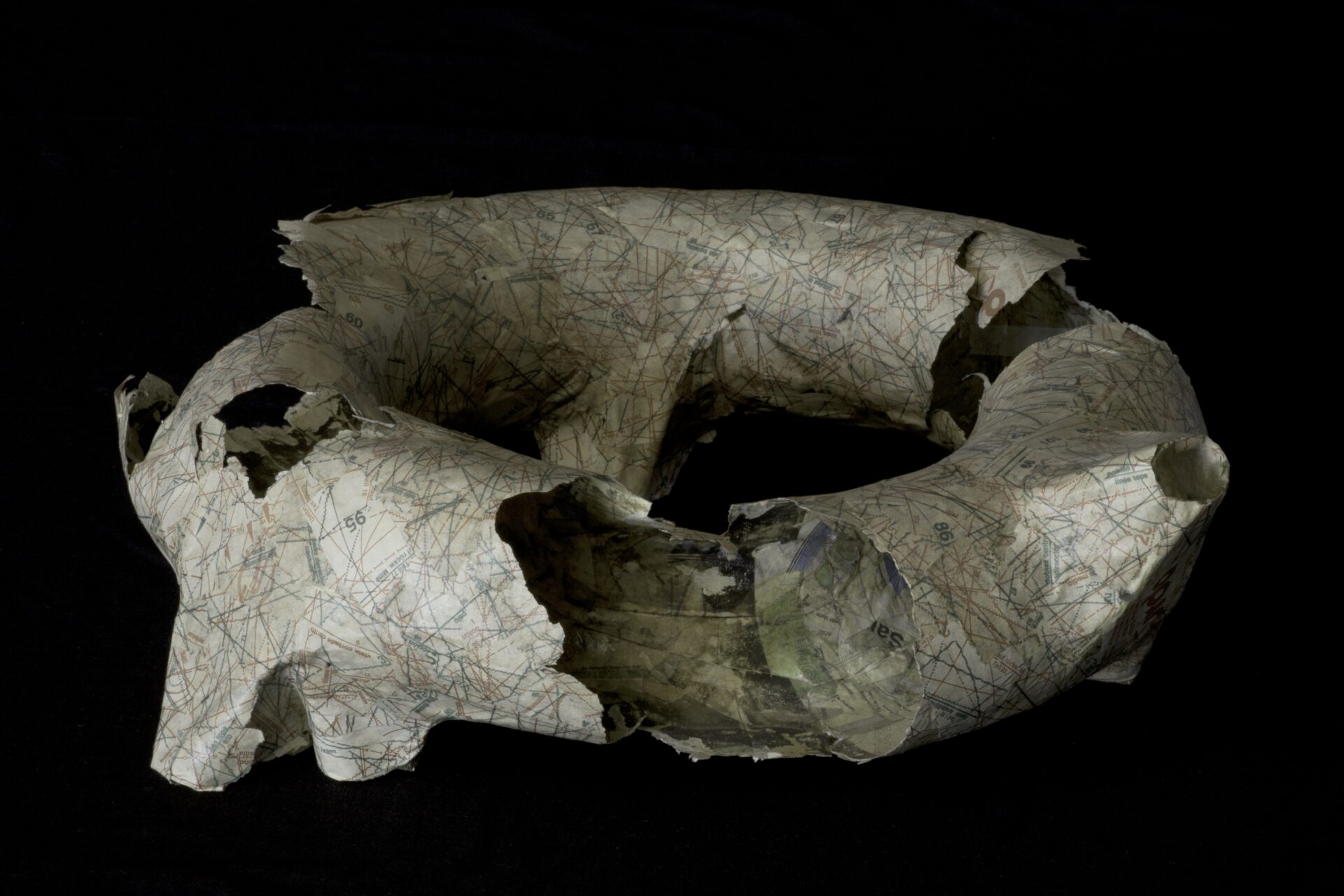
Radić, who established his own office in 1995, often uses collage in his models. He likes to apply newspaper so that the columns of text wrap around each other to create three-dimensional forms—an architecture literally and figuratively made of words. He uses these models to test forms that would encompass his text-based inspirations. This is best communicated in his 2011 project The Boy Hidden in an Egg, inspired by the eponymous etching by David Hockney and the Brothers Grimm fairy tale “The Little Sea Hare.”
In the story, a boy rises to the challenge of winning the heart of a princess by approaching her magical tower without being seen. In one of his three attempts, he hides within an egg. Radić translates this narrative into a model made from a cow’s udder stuffed with newspaper and taped with strips of wallpaper. The resulting bulbous form hovers tentatively above a wooden base, and below it, a scale figure is used to illustrate how the space below will be experienced and occupied. The odd use of materials gives it a visceral tactility, while the shift in the scale of the egg—from what we understand an egg to be, to its size in the story where a boy hides within it, to Radić’s translation of the egg at the building scale—takes on a new meaning in our imagination.
The Serpentine Pavilion was a culmination of many of Radić’s previous projects. Radić was also inspired by Oscar Wilde’s short story “The Selfish Giant.” In Wilde’s tale, a giant possesses a castle with a beautiful garden but does not want to share it with the children living nearby. He builds a wall to keep them out, but the wall also enforces a permanent state of winter on his property. One day, the children break in through a hole in the wall and bring the garden back to life, thereby winning over the giant as well. “The selfish giant’s castle is a refuge for him to hide from the children in the story,” explains Radić. “But the refuge is broken by weathering over the winter and he has to open it to the children again. This is more or less the same as the pavilion—an opaque and closed form that is punctured to open it up to the people around it, because it is a public pavilion.”[11]
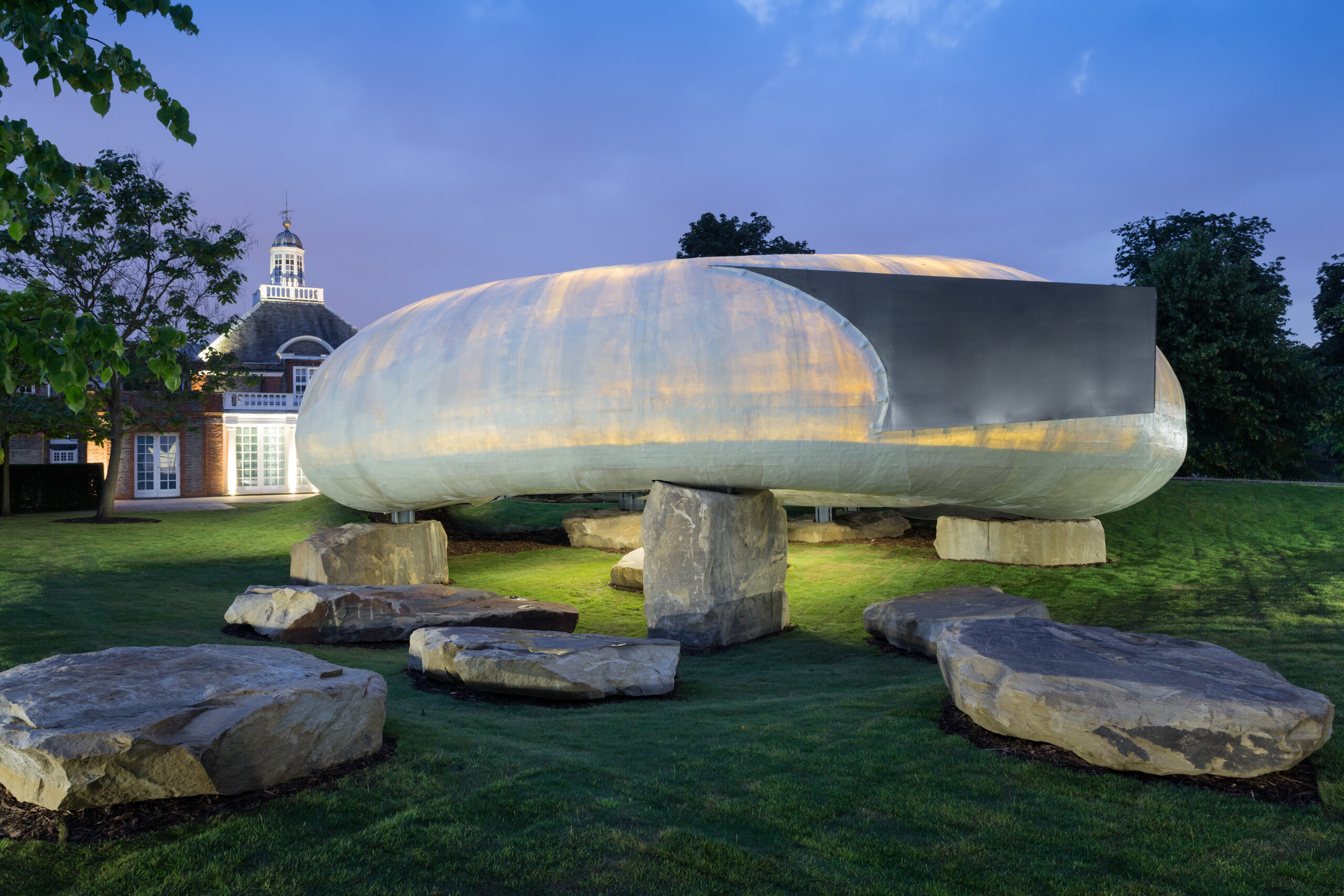
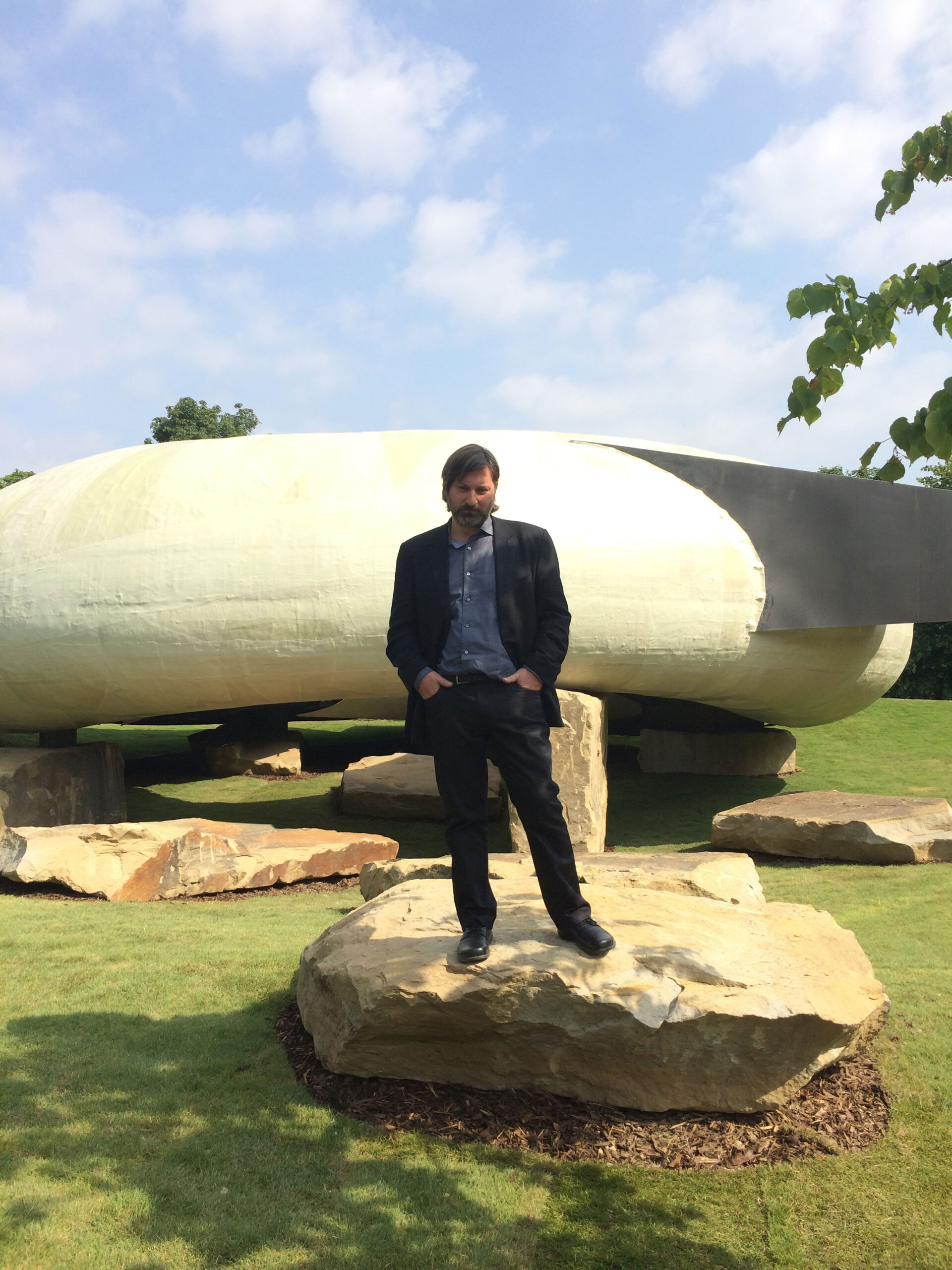
The pavilion, a torus-shaped floating volume that lightly rests on large stone boulders, looks like a life-size version of one of Radić’s earlier models. The overlapped surfaces of papier-mâché and brown packing tape are translated into sheets of glass-reinforced plastic, which produces a golden glow in the interior during the day and from the exterior at night (fig. 6). The irregular openings are primitive, cracking the volume open as if by force of nature. The cool refuge shelters visitors from the sun and is evidence of how Radić interpreted the text, aiming to recreate the relief felt by the giant upon returning to his castle to avoid the children. The openings and the central courtyard, made possible by the doughnut shape of the building, let in air and light, reminding us (and the giant) of the world outside.
Radić is pushing the boundaries of architecture. In a profession currently dominated by flashy visualizations and high-resolution imagery, he prefers the qualities of a space to its aesthetics. His playful approach toward form-finding, or rather “the collection of found shapes,”[12] begins with text, since it helps create imagery in his head. The final form of his pavilion was much more about testing an idea and finding ways to determine the unusual tectonics of the building throught his interpretation of the fairy-tale narrative, than about creating a beautiful or iconic building.
The interest in and importance of text in his work has been there from the very beginning. Radić’s first project Dolores, a boat house made from a variety of materials including tin, wood, and river stones, was significant because it allowed him to integrate his interest in literature into his architectural work, “to translate a narrative into a built form.”[13] Even his house was inspired by and named after Le Corbusier’s “Le Poeme de L’Angle Droit” (The Poem of the Right Angle), thus manifesting Corbusier’s ideas about nature, the human Modulor of scale and light. With protruding structures that frame views of the surrounding landscape, warm materials, and a central courtyard walled in by glass, the building becomes part of the nature that surrounds it, blending into the forest itself. Through experimentation Radić has hit upon a unique approach to designing architecture, translating words into imagined rather than manufactured images.
Yet Radić still questions his own ability to operate in architecture and literature simultaneously. According to him, “the use of literature to imagine architecture is an escapist exercise that often has dire consequences.”[14] This shows an awareness of the danger of getting lost in the fairy-tale narrative or taking the story too literally when building his architecture. Not averse to risk, however, Radić perseveres, escaping to this world of fantasy to source ideas and then returning to reality to make them tangible, physical, material—real.
Constraints are present in the work of both Perec and Radić. The strict rules Perec set himself were part of his design process, and while Radić doesn’t have constraints per se, he combines the technique of collage with written narratives to inform his process instead of having a definitive style. It would be intriguing, though, if Radić pushed the use of text even further to a Perecian extreme, creating an even tighter relationship between the words and his spaces. I have often wondered what Perec’s architecture would be like if built, and Radić’s love of text that obviously translates into his own writing about his projects makes me speculate on how a novel or fairy-tale by Radić would read?
The comparison between Perec and Radić serves to illustrate the similarities between writing and building. Both men are architects of text, designing spaces with words. They each move between architecture and literature, using one to visualize the other. Perec uses a single plan in the lengthy appendix to Life: A User’s Manual to illustrate the overlap between past and present inhabitants, while Radić champions the physical model as his visual transcript. Both works demand participation from their audience to be read, imagined, and interpreted.
More often than not, when a favorite book has been translated into a movie, viewers are disappointed after watching the film. The moving image, for all its technical superiority and captivating effects, fails, most of the time, in capturing the stories, characters, and events that we have painted in our minds. Perec was originally inspired to write Life: A User’s Manual after seeing a drawing from Saul Steinberg’s The Art of Living that cuts a section through an apartment building block, showing vignettes of the lives within. But after reading Perec’s text, even Steinberg’s image falls short in terms of its complexity, detail, and personality. This, alongside the attempts to forensically reconstruct or visualize Perec’s apartment building as seen on the many versions of the book’s cover, is always slightly anticlimactic. None of them ever live up to the rabbit warren of spaces envisaged in one’s mind. Perhaps this is because Perec’s words go beyond merely illustrating what lies behind the standard Haussmannian façades of Paris. Not only does he take us on a tour of the one hundred rooms of this apartment block, but he also slowly and subtly reveals a few elements of the underlying structure and devices that construct his narrative, hinting at the much larger scale of the hand of the creator or author that shapes the building and all the lives within it.
Imagine a future where architecture is explained, described, and delineated through text rather than images. It would require us to read actively rather than just observing passively, and it would force us to engage with the project’s intellectual core, so that the imagination of the architect and that of the reader meet somewhere in the middle. Renderings are seductive through their hyperrealism, but they also tie down a scheme and commit it to being designed in a particular way at too early a stage in the process. Complex architectural jargon confuses clients and makes the project impenetrable. However, a simple, evocative text describing a project in its intricacy has more power than any static image.
Marshall McLuhan once famously said that “the medium is the message.”[15] In reading both Perec’s book and Radić’s description, it feels as if we were transplanted into the spaces they describe. Their message is not just to create a space, but to create a multisensory experience. Text is the ideal medium for this spatiotemporal transport since words trigger memories, which in turn construct unique meanings for each individual reading the words. In a strange sense, this gives rise to something similar to synesthesia, a neurological condition where the body’s response to stimuli is confused, allowing a person to, for example, smell color or taste music. With these texts, you begin to hear, touch, and taste pictures translated through your mind’s eye.
Even though text is omnipresent in architecture, we have not fully realized its potential. It is used to construct briefs, articles, events, projects, and spaces, but it can also be a powerful medium to blur the boundaries between academia and practice, reality and fiction, author and readers. Words can be both personal and general, argumentative and descriptive; as Perec himself points out in Species of Spaces and Other Pieces: “This is how space begins, with words only, signs traced on the blank page.”[16]
Writing could become an even more integral part of the literary architect’s process. Similar to sketching, it clarifies and organizes thoughts, giving them structure and meaning. Perec made authors realize that structure and constraints could work in tandem with the telling of a good story. Similarly, Radić has shown how text and architecture can be woven together in the design process in a playful rather than didactic way. The bridge between Perec and Radić, literature and architecture, words and spaces, could pave the way to unlock the innate power within writing that has the potential to change how we understand architecture and the tools with which it is created.
[1] Arthur Brisbane, “Speakers Give Sound Advice,” Syracuse Post Standard, March 28, 1911, p. 18.
[2] Constrained writing refers to a literary technique in which the author of a text is bound to strict restrictions concerning vocabulary, spelling, or punctuation.
[3] Oulipo––a short form of Ouvroir de littérature potentielle, denoting the workshop of potential literature in French––used constraints as a means of generating ideas and new forms of writing. It was founded in November 1960 as part of the Collège de Pataphysique, a school devoted to pataphysics, “the science of imaginary solutions,” or to everything beyond the realm of metaphysics. Its members included authors such as Raymond Queneau and Italo Calvino, as well as the artist Marcel Duchamp. See also Alfred Jarry, Exploits and Opinions of Dr. Faustroll, Pataphysician, trans. Simon Watson Taylor (Cambridge, MA, 1996), p. 21.
[4] Nan Ellin, Postmodern Urbanism (New York, 1999), p. 42.
[5] Peta Mitchell, “Constructing the Architext: George Perec’s Life a User’s Manual,” Mosaic 37, no. 1 (2004), pp. 1–16, esp. p. 1.
[6] Georges Perec, Life: A User’s Manual, trans. David Bellos (London, 2008), p. 500.
[7] Adolf Loos, “Regarding Economy,” in Raumplan versus Plan Libre: Adolf Loos [and] Le Corbusier, ed. Max Risselada (1988; repr., Rotterdam, 2008), pp. 173–77, esp. p. 175.
[8] Serpentine Gallery, “Serpentine Pavilion 2014 Designed by Smiljan Radić,” in Serpentine Pavilion press release (London, 2014), p. 4.
[9] Fabrizio Gallanti, “Disquiet Rooms: The Uncertain Architecture of Smiljan Radić,” in Smiljan Radić, Serpentine Gallery Pavilion 2014 (London, 2014).
[10] Smiljan Radić in conversation with the author, June 24, 2014.
[11] Ibid.
[12] Ibid.
[13] Smiljan Radić, Julia Peyton-Jones and Hans Ulrich Obrist, “In Conversation,” in Smiljan Radić, Serpentine Gallery Pavilion 2014 (London 2014).
[14] Smiljan Radić, “The Selfish Giant’s Castle,” El Croquis 167 (2013), p. 223.
[15] Marshall McLuhan, Understanding Media: The Extensions of Man (New York, 1964), p. 7.
[16] Georges Perec, Species of Spaces and Other Pieces, trans. John Sturrock (London, 2008), p. 13.